Archive for August, 2011
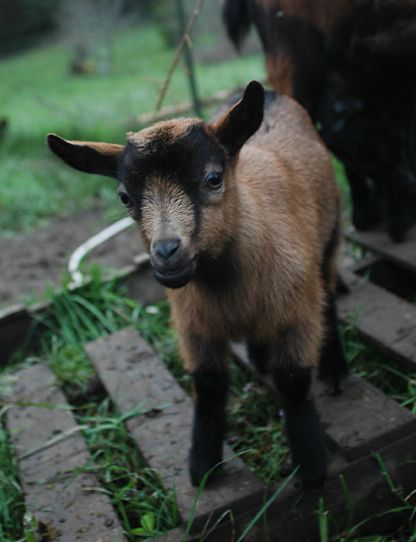
This is Sephira, one of Zoe’s daughters from this year, at one month old. She is now four months old, and has gone to live at her new home, with her uncle Barnabas and aunt Clarisse (Aberdeen’s kids from last year). I can’t believe I didn’t get any more recent photos of her before she left, but fortunately her new person has already sent us several photos of her in her new digs.
Some of our critters get to stay with us for years, but some are with us only for a short time. It’s getting easier to accept that, as time goes by.
Our current totals, including both the recent losses (to hawk and to hatchet) and the recent gains (namely, Maud’s new chicks):
- 31 chickens (it’s too early to tell the gender for sure yet on this year’s chicks, but those that turn out to be male will be destined for “freezer camp”);
- 9 goats (two of which are for sale: Zoe’s other daughter, Isis, and Lulu’s boy, Galahad – details on those two coming soon!);
- 1 dog;
- 1 cat;
- …and hundreds of plants!
Comments (3)
+
New goat house almost ready!
August 2, 2011 By Peter
Filed under: Construction,Goats,Hillbilly Engineering,How NOT To,How To,Pets and Livestock
We’re moving our goats to a new area about 300′ from the old one, and the new goat house is almost ready. No, I’m not using a cheap camera; 90° angles are rare here, due to the use of salvaged lumber and also my inexperience with building anything on this scale; it’s sometimes difficult to push a thousand pounds of lumber into the perfect position and secure it with just two hands. But it’s darn solid and should be much nicer for the goats.
Here’s the front, with a nice wide door, to reduce the bottleneck when 9 goats try to rush through at once:
The basic structure is 4x4s with plywood sheathing, which would not stand up to the antics of a goat herd for very long, so the lower part inside is reinforced with, what else, shipping pallets:
…and their new pasture area is really, really ready for some munchin’:
The basic structure is 4x4s with plywood sheathing, which would not stand up to the antics of a goat herd for very long, so the lower part inside is reinforced with, what else, shipping pallets:
…and their new pasture area is really, really ready for some munchin’:
In all seriousness, we don’t begrudge the little fellas the occasional onion or beet; they contribute far more to the garden than they take. Howzat?
Bear with me a moment and I’ll get to it.
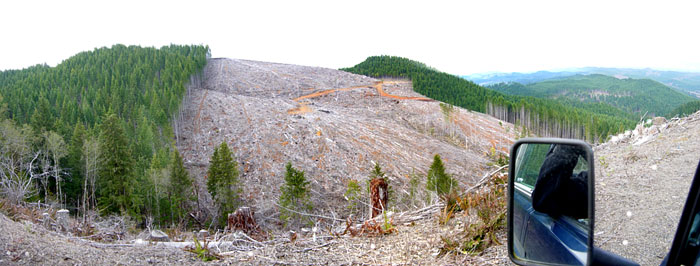
Before industrial agriculture and forestry came around, the ground here was thickly covered in rich, fluffy duff. You can still go into the few remaining scraps of old growth forest and easily push your hand a foot or more into the ground to see what it’s like. If it wasn’t so scarce I’d harvest some as the world’s best potting soil, but it’s mostly been destroyed and takes centuries to recover, so I don’t.After a clearcut:
…much of the fungal and microbial life that contributes to building this amazing soil is killed off by the sunlight, and fertility is rapidly lost to the dry winds in summer (several months of no rain) and erosion in the winter (~8 months of constant rain). Eventually, what’s left is orange clay that can support only the most persistent “weeds” and deep-rooted trees. Eventually, the hardy, brushy plants will build a new soil layer, but people don’t live that long.
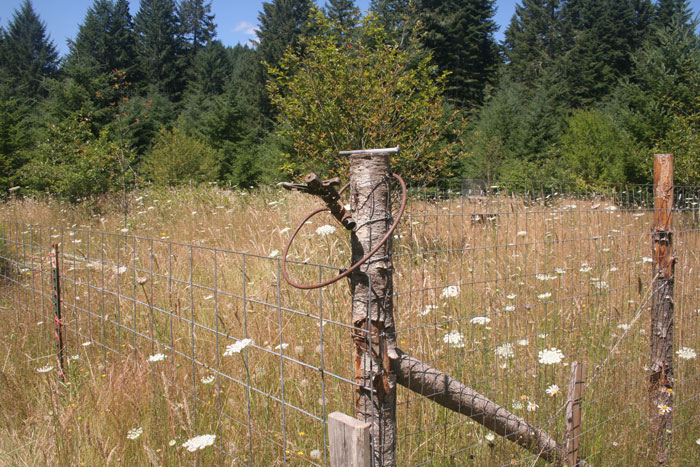
It’s not that bad on our little patch, because the land has been allowed to recover to some extent, but several inches beneath the surface it’s pretty much pure pottery. This is where the voles and other tunneling creatures are indispensable – their tunnels help the rainwater get down to the river without taking everything else along with it, and they break up the hard clay, mixing in the soil that they move around and of course leaving “fertilizer” in their wake.
So they’re quite welcome to a certain share of our harvest; they help us produce it!
It’s Lammas, traditionally a time to celebrate the first harvests of the year, and despite the seemingly endless coldwetwinterspring weather, we’re actually starting to have something to harvest.
Bees are enjoying the onions that have been allowed to go to flower:
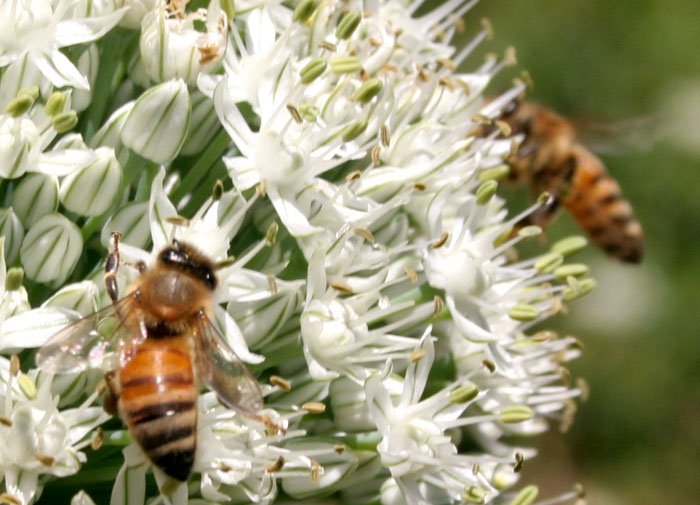
I wonder what the honey will taste like?
It’s a great year for some things, like our tart state plant, the Oregon Grape:
It’s not actually in the grape family, but it makes a really delicious dry fruit wine.
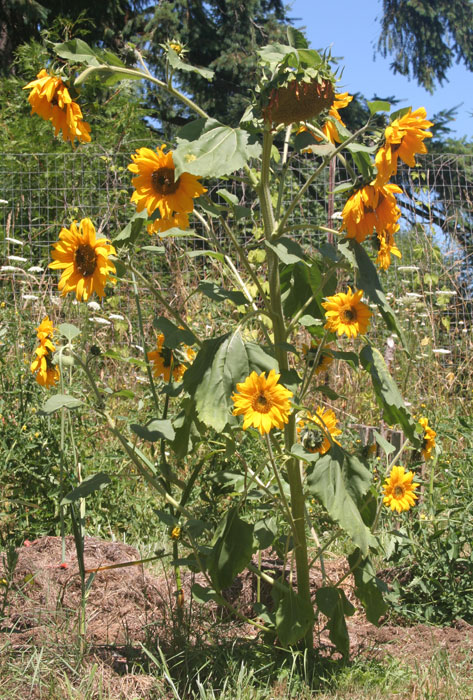
Some year soon, we’re going to have to do a huge field of black oil sunflowers, which are a staple item for our goats and chickens. This is a volunteer, and a spectacular example; I lost count at 27 flowers on this one 6′ tall plant:
Most of the remaining garlic and onions were pulled this morning and now hang from the rafters in the living room:
I am not recommending this as an air freshener. Especially on a hot day when the windows are closed to hold in the cool nighttime air.
Tomato plants are finally setting fruit, and are overflowing the former garlic and onion beds:
We planted about 7 different varieties of tomato this year, purchased as small starts from Boondockers Farm, a great place for heirloom seeds and starts near Eugene.
Boondockers have been working with several obscure (to me, at least) tomatoes, fusing their goals of preserving heirloom DNA and finding varieties that thrive in our particular climate.
Evan, who owns the farm with his partner Rachel, was kind enough to spend an inordinate amount of time educating someone (me) who was only buying one tray of discounted starts. Several of the ones I chose from their almost overwhelming selection are of Eastern European origin, with names like De Barrao Black Ukrainian, Kosovo, and Malakhitovaya Shkatulka. The ones with less exotic names sound no less enticing – Chocolate Cherry, Black Zebra, Chocolate Stripes.
I carefully placed little tags next to each start so I could assess the varieties for future planting, but now there are a few mystery plants…the sometimes frustratingly persistent ink of a Sharpie marker has no UV resistance whatsoever =\
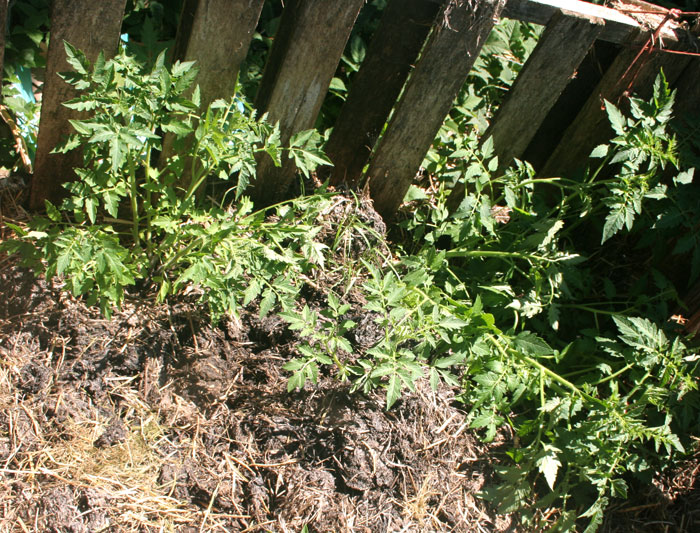
I also don’t know what variety of tomato these are; they popped up voluntarily in a compost bin:
The first round of potatoes is in, and the yield is not overwhelming but better than my previous efforts.
I did not know this before, but “potatoes,” like most of our roots and tubers, are things we plant and care for in order to keep the tunneling moles well nourished. Kidding, but not entirely; I’ll explain in the next post.
I wonder what the honey will taste like?
It’s a great year for some things, like our tart state plant, the Oregon Grape:
It’s not actually in the grape family, but it makes a really delicious dry fruit wine.
Some year soon, we’re going to have to do a huge field of black oil sunflowers, which are a staple item for our goats and chickens. This is a volunteer, and a spectacular example; I lost count at 27 flowers on this one 6′ tall plant:
Most of the remaining garlic and onions were pulled this morning and now hang from the rafters in the living room:
I am not recommending this as an air freshener. Especially on a hot day when the windows are closed to hold in the cool nighttime air.
Tomato plants are finally setting fruit, and are overflowing the former garlic and onion beds:
We planted about 7 different varieties of tomato this year, purchased as small starts from Boondockers Farm, a great place for heirloom seeds and starts near Eugene.
Boondockers have been working with several obscure (to me, at least) tomatoes, fusing their goals of preserving heirloom DNA and finding varieties that thrive in our particular climate.
Evan, who owns the farm with his partner Rachel, was kind enough to spend an inordinate amount of time educating someone (me) who was only buying one tray of discounted starts. Several of the ones I chose from their almost overwhelming selection are of Eastern European origin, with names like De Barrao Black Ukrainian, Kosovo, and Malakhitovaya Shkatulka. The ones with less exotic names sound no less enticing – Chocolate Cherry, Black Zebra, Chocolate Stripes.
I carefully placed little tags next to each start so I could assess the varieties for future planting, but now there are a few mystery plants…the sometimes frustratingly persistent ink of a Sharpie marker has no UV resistance whatsoever =\
I also don’t know what variety of tomato these are; they popped up voluntarily in a compost bin:
The first round of potatoes is in, and the yield is not overwhelming but better than my previous efforts.
I did not know this before, but “potatoes,” like most of our roots and tubers, are things we plant and care for in order to keep the tunneling moles well nourished. Kidding, but not entirely; I’ll explain in the next post.
Recent Posts
- Goats for sale!
- Harvest time is so beautiful…
- Three Turkens and a Welsummer
- Sephira
- Sweet Maud and her tiny little peeps
- New goat house almost ready!
- Darn moles and voles? Darn helpful, actually.
- Lammas 2011: harvesting alliums and hoping for exotic tomatoes
- “Goat crossing”
- Heeler dog: possibly the most important animal on a small farm
Recent Comments
- Winnie on Harvest time is so beautiful…
- Peter on Saris Bones bike rack front-mounted on a Vanagon
- Lynn on Saris Bones bike rack front-mounted on a Vanagon
- Kelly Lomax on New goat house almost ready!
- Kelly Lomax on Who we are
- Peter on How to breed dairy goats
- lucien on How to breed dairy goats
- Janet on Sephira
- Peter on Learning to grow tobacco in Oregon
- sean on Learning to grow tobacco in Oregon
Categories
- Cheese Making
- Chickens
- Construction
- Cooking
- Current Events
- Flowers
- Food Preservation
- Foraging
- Funny haha
- Gardening
- General Homesteading
- Goats
- Hillbilly Engineering
- Home Brewing
- How NOT To
- How To
- Livestock for sale
- Oregon Weather
- Pets and Livestock
- Predators
- Recipes
- Sights
- Sustainability
- Tobacco
- Vanagon Stuff 2006-7
- What Are Your Days Like?
- Working Dogs
Archives
- August 2012
- September 2011
- August 2011
- July 2011
- June 2011
- May 2011
- April 2011
- March 2011
- November 2010
- October 2010
- September 2010
- August 2010
- July 2010
- June 2010
- May 2010
- April 2010
- March 2010
- February 2010
- December 2009
- November 2009
- October 2009
- August 2009
- July 2009
- June 2009
- April 2009
- March 2009
- February 2009
- December 2008
- November 2008
- October 2008
- September 2008
- August 2008
- July 2008
- June 2008
- May 2008
- April 2008
- March 2008
- February 2008
- January 2008
- December 2007
- November 2007
- October 2007
- September 2007
- August 2007
- July 2007
- June 2007
- May 2007
- April 2007
- March 2007
- February 2007
- January 2007
- December 2006
- November 2006
- October 2006
- September 2006
- August 2006
- July 2006
- June 2006
- May 2006
- April 2006
- March 2006
- February 2006
- January 2006
- September 2005